Hadith Imam Bukhari about Partnership
Jul 25, 2009Book 3 :: Volume 44 :: Hadith 674
Narrated 'Urwa bin Az-Zubair:
That he had asked 'Aisha about the meaning of the Statement of Allah: "If you fear that you shall not Be able to deal justly With the orphan girls, then Marry (Other) women of your choice Two or three or four." (4.3)
She said, "O my nephew! This is about the orphan girl who lives with her guardian and shares his property. Her wealth and beauty may tempt him to marry her without giving her an adequate Mahr (bridal-money) which might have been given by another suitor. So, such guardians were forbidden to marry such orphan girls unless they treated them justly and gave them the most suitable Mahr; otherwise they were ordered to marry any other woman." 'Aisha further said, "After that verse the people again asked the Prophet (about the marriage with orphan 'girls), so Allah revealed the following verses:-- 'They ask your instruction Concerning the women. Say: Allah Instructs you about them And about what is Recited unto you In the Book, concerning The orphan girls to whom You give not the prescribed portions and yet whom you Desire to marry..." (4.127)
 Image via Wikipedia
What is meant by Allah's Saying:-- 'And about what is Recited unto you is the former verse which goes:-- 'If you fear that you shall not Be able to deal justly With the orphan girls, then Marry (other) women of your choice.' (4.3) 'Aisha said, "Allah's saying in the other verse:--'Yet whom you desire to marry' (4.127) means the desire of the guardian to marry an orphan girl under his supervision when she has not much property or beauty (in which case he should treat her justly). The guardians were forbidden to marry their orphan girls possessing property and beauty without being just to them, as they generally refrain from marrying them (when they are neither beautiful nor wealthy)."
Book 3 :: Volume 44 :: Hadith 675
Narrated Jabir bin 'Abdullah:
The Prophet established the right of Shu'fa (i.e. Pre-emption) in joint properties; but when the land is divided and the ways are demarcated, then there is no pre-emption.
Book 3 :: Volume 44 :: Hadith 676
Narrated Jabir bin 'Abdullah:
The Prophet said, "The right of pre-emption is valid in every joint property, but when the land is divided and the way is demarcated, then there is no right of pre-emption."
Book 3 :: Volume 44 :: Hadith 677
Narrated Sulaiman bin Abu Muslim:
I asked Abu Minhal about money exchange from hand to hand. He said, "I and a partner of mine bought something partly in cash and partly on credit." Al-Bara' bin 'Azib passed by us and we asked about it. He replied, "I and my partner Zaid bin Al-Arqam did the same and then went to the Prophet and asked him about it. He said, 'Take what was from hand to hand and leave what was on credit.' "
Book 3 :: Volume 44 :: Hadith 678
Narrated Abdullah:
Allah's Apostle rented the
Book 3 :: Volume 44 :: Hadith 679
Narrated 'Uqba bin 'Amir:
that Allah's Apostle gave him some sheep to distribute among his companions in order to sacrifice them and a kid was left. He told the Prophet about it and the Prophet said to him, "Sacrifice it on your behalf."
Book 3 :: Volume 44 :: Hadith 680
Narrated 'Abdullah bin Hisham:
that his mother Zainab bint Humaid took him to the Prophet and said, "O Allah's Apostle! Take the pledge of allegiance from him." But he said, "He is still too young for the pledge," and passed his hand on his (i.e. 'Abdullah's) head and invoked for Allah's blessing for him. Zuhra bin Ma'bad stated that he used to go with his grandfather, 'Abdullah bin Hisham, to the market to buy foodstuff. Ibn 'Umar and Ibn Az-Zubair would meet him and say to him, "Be our partner, as the Prophet invoked Allah to bless you." So, he would be their partner, and very often he would win a camel's load and send it home.
Book 3 :: Volume 44 :: Hadith 681
Narrated Ibn 'Umar:
The Prophet said, "Whoever manumits his share o a jointly possessed slave, it is imperative on him to manumit the slave completely if he has sufficient money to pay the rest of its price which is to be estimated justly. He should pay his partners their shares and release him (the freed one).
Book 3 :: Volume 44 :: Hadith 682
Narrated Abu Huraira:
The Prophet said, "Whoever manumits his share of a jointly possessed slave, it is essential for him to manumit the slave completely if he has sufficient money. Otherwise he should look for some work for the slave (to earn what would enable him to emancipate himself), without overburdening him with work."
Book 3 :: Volume 44 :: Hadith 683
Narrated Ibn 'Abbas:
The Prophet (along with his companions) reached
Book 3 :: Volume 44 :: Hadith 684
Narrated Abaya bin Rifaa:
My grandfather, Rafi bin Khadij said, "We were in the
![Reblog this post [with Zemanta]](http://img.zemanta.com/reblog_e.png?x-id=7aea9092-d988-429c-a3dc-a8ffe2ad9946)
Hadith Imam Bukhari about Partnership
Jul 24, 2009Book 3 :: Volume 44 :: Hadith 663
Narrated Jabir bin 'Abdullah:
"Allah's Apostle sent an army towards the east coast and appointed Abu 'Ubaida bin Al-Jarrah as their chief, and the army consisted of three-hundred men including myself. We marched on till we reached a place where our food was about to finish. Abu- 'Ubaida ordered us to collect all the journey food and it was collected. My (our) journey food was dates. Abu 'Ubaida kept on giving us our daily ration in small amounts from it, till it was exhausted. The share of everyone of us used to be one date only." I said, "How could one date benefit you?" Jabir replied, "We came to know its value when even that too finished." Jabir added, "When we reached the sea-shore, we saw a huge fish which was like a small mountain. The army ate from it for eighteen days. Then Abu 'Ubaida ordered that two of its ribs be fixed and they were fixed in the ground. Then he ordered that a she-camel be ridden and it passed under the two ribs (forming an arch) without touching them."
Book 3 :: Volume 44 :: Hadith 664
 Image via Wikipedia
Narrated Salama:
Once the journey food diminished and the people were reduced to poverty. They went to the Prophet and asked his permission to slaughter their camels, and he agreed. 'Umar met them and they told him about it, and he said, "How would you survive after slaughtering your camels?" Then he went to the Prophet and said, "O Allah's Apostle! How would they survive after slaughtering their camels?" Allah's Apostle ordered 'Umar, "Call upon the people to bring what has remained of their food." A leather sheet was spread and al I the journey food was collected and heaped over it. Allah's Apostle stood up and invoked Allah to bless it, and then directed all the people to come with their utensils, and they started taking from it till all of them got what was sufficient for them. Allah's Apostle then said, "I testify that None has the right to be worshipped but Allah, and I am His Apostle. "
Book 3 :: Volume 44 :: Hadith 665
Narrated Rafi bin Khadij:
We used to offer the 'Asr prayer with the Prophet and slaughter a camel, the meat of which would be divided in ten parts. We would eat the cooked meat before sunset.
Book 3 :: Volume 44 :: Hadith 666
Narrated Abu Musa:
The Prophet said, "When the people of Ash'ari tribe ran short of food during the holy battles, or the food of their families in
Book 3 :: Volume 44 :: Hadith 667
Narrated Anas:
that Abu Bakr As-Siddiq wrote to him the law of Zakat which was made obligatory by Allah's Apostle. He wrote: 'Partners possessing joint property (sheep) have to pay its Zakat equally.
Book 3 :: Volume 44 :: Hadith 668
Narrated 'Abaya bin Rafa'a bin Raft' bin Khadij:
My grandfather said, "We were in the company of the Prophet at Dhul-Hulaifa. The people felt hungry and captured some camels and sheep (as booty). The Prophet was behind the people. They hurried and slaughtered the animals and put their meat in pots and started cooking it. (When the Prophet came) he ordered the pots to be upset and then he distributed the animals (of the booty), regarding ten sheep as equal to one camel. One of the camels fled and the people ran after it till they were exhausted. At that time there were few horses. A man threw an arrow at the camel, and Allah stopped the camel with it. The Prophet said, "Some of these animals are like wild animals, so if you lose control over one of these animals, treat it in this way (i.e. shoot it with an arrow)." Before distributing them among the soldiers my grandfather said, "We may meet the enemies in the future and have no knives; can we slaughter the animals with reeds?" The Prophet said, "Use whatever causes blood to flow, and eat the animals if the name of Allah has been mentioned on slaughtering them. Do not slaughter with teeth or fingernails and I will tell you why: It is because teeth are bones (i.e. cannot cut properly) and fingernails are the tools used by the Ethiopians (whom we should not imitate for they are infidels)."
Book 3 :: Volume 44 :: Hadith 669
Narrated Ibn 'Umar:
The Prophet decreed that one should not eat two dates together at a time unless he gets the permission from his companions (sharing the meal with him).
Book 3 :: Volume 44 :: Hadith 670
Narrated Jabala:
"While at
Book 3 :: Volume 44 :: Hadith 671
Narrated Nafi:
Ibn 'Umar said, "Allah's Apostle said, 'If one manumits his share of a jointly possessed slave, and can afford the price of the other shares according to the adequate price of the slave, the slave will be completely manumitted; otherwise he will be partially manumitted.' " (Aiyub, a sub-narrator is not sure whether the saying " ... otherwise he will be partially manumitted" was said by Nafi' or the Prophet.)
Book 3 :: Volume 44 :: Hadith 672
Narrated Abu Huraira:
The Prophet said, "Whoever manumits his share of a jointly possessed slave, it is imperative for him to get that slave manumitted completely by paying the remaining price, and if he does not have sufficient money to manumit him, then the price of the slave should be estimated justly, and he is to be allowed to work and earn the amount that will manumit him (without overburdening him)".
Book 3 :: Volume 44 :: Hadith 673
Narrated An-Nu'man bin Bashir:
The Prophet said, "The example of the person abiding by Allah's order and restrictions in comparison to those who violate them is like the example of those persons who drew lots for their seats in a boat. Some of them got seats in the upper part, and the others in the lower. When the latter needed water, they had to go up to bring water (and that troubled the others), so they said, 'Let us make a hole in our share of the ship (and get water) saving those who are above us from troubling them. So, if the people in the upper part left the others do what they had suggested, all the people of the ship would be destroyed, but if they prevented them, both parties would be safe."
![Reblog this post [with Zemanta]](http://img.zemanta.com/reblog_e.png?x-id=2f46e060-1ada-4b51-838c-bcef836c52cc)
Hadith Imam Bukhari about Oppressions
Jul 23, 2009Book 3 :: Volume 43 :: Hadith 652
Narrated Abu Huraira:
Allah's Apostle said, "While a man was on the way, he found a thorny branch of a tree there on the way and removed it. Allah thanked him for that deed and forgave him."
Book 3 :: Volume 43 :: Hadith 653
Narrated Abu Huraira:
The Prophet judged that seven cubits should be left as a public way when there was a dispute about the land.
Book 3 :: Volume 43 :: Hadith 654
Narrated 'Abdullah bin Yazid Al-Ansari:
The Prophet forbade robbery (taking away what belongs to others without their permission), and also forbade mutilation (or maiming) of bodies.
Book 3 :: Volume 43 :: Hadith 655
Narrated Abu Huraira:
The Prophet said, "When an adulterer commits illegal sexual intercourse, then he is not a believer at the time, he is doing it, and when a drinker of an alcoholic liquor drinks it, then he is not a believer at the time of drinking it, and when a thief steals, then he is not a believer at the time of stealing, and when a robber robs, and the people look at him, then he is not a believer at the time of doing robbery.
Book 3 :: Volume 43 :: Hadith 656
Narrated Abu Huraira:
Allah's Apostle said, "The Hour will not be established until the son of Mary (i.e. Jesus) descends amongst you as a just ruler, he will break the cross, kill the pigs, and abolish the Jizya tax. Money will be in abundance so that nobody will accept it (as charitable gifts).
Book 3 :: Volume 43 :: Hadith 657
Narrated Salama bin Al-Akwa:
On the day of Khaibar the Prophet saw fires being lighted. He asked, "Why are these fires being lighted?" The people replied that they were cooking the meat of donkeys. He said, "Break the pots and throw away their contents." The people said, "Shall we throw away their contents and wash the pots (rather than break them)?" He said, "Wash them."
Book 3 :: Volume 43 :: Hadith 658
Narrated 'Abdullah bin Masud:
The Prophet entered
Book 3 :: Volume 43 :: Hadith 659
Narrated Al-Qasim:
Aisha said that she hung a curtain decorated with pictures (of animates) on a cupboard. The Prophet tore that curtain and she turned it into two cushions which remained in the house for the Prophet to sit on.
Book 3 :: Volume 43 :: Hadith 660
Narrated 'Abdullah bin 'Amr bin Al-'As:
I heard the Prophet saying, "Whoever is killed while protecting his property then he is a martyr."
Book 3 :: Volume 43 :: Hadith 661
Narrated Anas:
While the Prophet was with one of his wives, one of the mothers of the believers (i.e. one of his wives) sent a wooden bowl containing food with a servant. The wife (in whose house he was sitting) stroke the bowl with her hand and broke it. The Prophet collected the shattered pieces and put the food back in it and said, "Eat." He kept the servant and the bowl till he had eaten the food. Then the Prophet gave another unbroken. bowl to the servant and kept the broken one.
Book 3 :: Volume 43 :: Hadith 662
Narrated Abu Huraira:
Allah's Apostle said, "There was an Israeli man called Juraij, while he was praying, his mother came and called him, but he did not respond to her call. He said (to himself) whether he should continue the prayer or reply to his mother. She came to him the second time and called him and said, "O Allah! Do not let him die until he sees the faces of prostitutes." Juraij used to live in a hermitage. A woman said that she would entice Juraij, so she went to him and presented herself (for an evil act) but he refused. She then went to a shepherd and allowed him to commit an illegal sexual intercourse with her and later she gave birth to a boy. She alleged that the baby was from Juraij. The people went to Juraij and broke down his hermitage, pulled him out of it and abused him. He performed ablution and offered the prayer, then he went to the male (baby) and asked him; "O boy! Who is your father?" The baby replied that his father was the shepherd. The people said that they would build for him a hermitage of gold but Juraij asked them to make it of mud only."
![Reblog this post [with Zemanta]](http://img.zemanta.com/reblog_e.png?x-id=6b1e58f5-2c0b-4c6e-966d-050cde44a8b1)
Hadith Imam Bukhari about Oppressions
Jul 22, 2009Book 3 :: Volume 43 :: Hadith 647
Narrated Usama bin Zaid:
Once the Prophet stood at the top of one of the castles (or higher buildings) of
Book 3 :: Volume 43 :: Hadith 648
Narrated 'Abdullah bin 'Abbas:
I had been eager to ask 'Umar about the two ladies from among the wives of the Prophet regarding whom Allah said (in the Qur'an saying): If you two (wives of the Prophet namely Aisha and Hafsa) turn in repentance to Allah your hearts are indeed so inclined (to oppose what the Prophet likes) (66.4), till performed the Hajj along with 'Umar (and on our way back from Hajj) he went aside (to answer the call of nature) and I also went aside along with him carrying a tumbler of water. When he had answered the call of nature and returned. I poured water on his hands from the tumbler and he performed ablution. I said, "O Chief of the believers! ' Who were the two ladies from among the wives of the Prophet to whom Allah said:
'If you two return in repentance (66.4)? He said, "I am astonished at your question, O Ibn 'Abbas. They were Aisha and Hafsa."
Then 'Umar went on relating the narration and said. "I and an Ansari neighbor of mine from Bani Umaiya bin Zaid who used to live in 'Awali Al-Medina, used to visit the Prophet in turns. He used to go one day, and I another day. When I went I would bring him the news of what had happened that day regarding the instructions and orders and when he went, he used to do the same for me. We, the people of Quraish, used to have authority over women, but when we came to live with the Ansar, we noticed that the Ansari women had the upper hand over their men, so our women started acquiring the habits of the Ansari women. Once I shouted at my wife and she paid me back in my coin and I disliked that she should answer me back. She said, 'Why do you take it ill that I retort upon you? By Allah, the wives of the Prophet retort upon him, and some of them may not speak with him for the whole day till night.' What she said scared me and I said to her, 'Whoever amongst them does so, will be a great loser.' Then I dressed myself and went to Hafsa and asked her, 'Does any of you keep Allah's Apostle angry all the day long till night?' She replied in the affirmative. I said, 'She is a ruined losing person (and will never have success)! Doesn't she fear that Allah may get angry for the anger of Allah's Apostle and thus she will be ruined? Don't ask Allah's Apostle too many things, and don't retort upon him in any case, and don't desert him. Demand from me whatever you like, and don't be tempted to imitate your neighbor (i.e. 'Aisha) in her behavior towards the Prophet), for she (i.e. Aisha) is more beautiful than you, and more beloved to Allah's Apostle.
In those days it was rumored that Ghassan, (a tribe living in Sham) was getting prepared their horses to invade us. My companion went (to the Prophet on the day of his turn, went and returned to us at night and knocked at my door violently, asking whether I was sleeping. I was scared (by the hard knocking) and came out to him. He said that a great thing had happened. I asked him: What is it? Have Ghassan come? He replied that it was worse and more serious than that, and added that Allah's Apostle had divorced all his wives. I said, Hafsa is a ruined loser! I expected that would happen some day.' So I dressed myself and offered the Fajr prayer with the Prophet. Then the Prophet entered an upper room and stayed there alone. I went to Hafsa and found her weeping. I asked her, 'Why are you weeping? Didn't I warn you? Have Allah's Apostle divorced you all?' She replied, 'I don't know. He is there in the upper room.' I then went out and came to the pulpit and found a group of people around it and some of them were weeping. Then I sat with them for some time, but could not endure the situation. So I went to the upper room where the Prophet was and requested to a black slave of his: "Will you get the permission of (Allah's Apostle) for Umar (to enter)? The slave went in, talked to the Prophet about it and came out saying, 'I mentioned you to him but he did not reply.' So, I went and sat with the people who were sitting by the pulpit, but I could not bear the situation, so I went to the slave again and said: "Will you get he permission for Umar? He went in and brought the same reply as before. When I was leaving, behold, the slave called me saying, "Allah's Apostle has granted you permission." So, I entered upon the Prophet and saw him lying on a mat without wedding on it, and the mat had left its mark on the body of the Prophet, and he was leaning on a leather pillow stuffed with palm fires. I greeted him and while still standing, I said: "Have you divorced your wives?' He raised his eyes to me and replied in the negative. And then while still standing, I said chatting: "Will you heed what I say, 'O Allah's Apostle! We, the people of Quraish used to have the upper hand over our women (wives), and when we came to the people whose women had the upper hand over them..."
'Umar told the whole story (about his wife). "On that the Prophet smiled." 'Umar further said, "I then said, 'I went to Hafsa and said to her: Do not be tempted to imitate your companion ('Aisha) for she is more beautiful than you and more beloved to the Prophet.' The Prophet smiled again. When I saw him smiling, I sat down and cast a glance at the room, and by Allah, I couldn't see anything of importance but three hides. I said (to Allah's Apostle) "Invoke Allah to make your followers prosperous for the Persians and the Byzantines have been made prosperous and given worldly luxuries, though they do not worship Allah?' The Prophet was leaning then (and on hearing my speech he sat straight) and said, 'O Ibn Al-Khatttab! Do you have any doubt (that the Hereafter is better than this world)? These people have been given rewards of their good deeds in this world only.' I asked the Prophet . 'Please ask Allah's forgiveness for me. The Prophet did not go to his wives because of the secret which Hafsa had disclosed to 'Aisha, and he said that he would not go to his wives for one month as he was angry with them when Allah admonished him (for his oath that he would not approach Maria). When twenty-nine days had passed, the Prophet went to Aisha first of all. She said to him, 'You took an oath that you would not come to us for one month, and today only twenty-nine days have passed, as I have been counting them day by day.' The Prophet said, 'The month is also of twenty-nine days.' That month consisted of twenty-nine days. 'Aisha said, 'When the Divine revelation of Choice was revealed, the Prophet started with me, saying to me, 'I am telling you something, but you needn't hurry to give the reply till you can consult your parents." 'Aisha knew that her parents would not advise her to part with the Prophet . The Prophet said that Allah had said:--
'O Prophet! Say To your wives; If you desire The life of this world And its glitter, ... then come! I will make a provision for you and set you free In a handsome manner. But if you seek Allah And His Apostle, and The Home of the Hereafter, then Verily, Allah has prepared For the good-doers amongst you A great reward.' (33.28) 'Aisha said, 'Am I to consult my parents about this? I indeed prefer Allah, His Apostle, and the Home of the Hereafter.' After that the Prophet gave the choice to his other wives and they also gave the same reply as 'Aisha did."
Book 3 :: Volume 43 :: Hadith 649
Narrated Anas:
Allah's Apostle took an oath that he would not go to his wives for one month as his foot had been sprained. He stayed in an upper room when 'Umar went to him and said, "Have you divorced your wives?" He said, "No, but I have taken an oath that I would not go to them for one month." The Prophet stayed there for twenty-nine days, and then came down and went to his wives.
Book 3 :: Volume 43 :: Hadith 650
Narrated Jabir:
The Prophet entered the Mosque, and I too went there after tying the camel at the pavement of the Mosque. I said (to the Prophet ), "This is your camel." He came out and started examining the camel and said, "Both the camel and its price are for you."
Book 3 :: Volume 43 :: Hadith 651
Narrated Hudhaifa:
I saw Allah's Apostle coming (or the Prophet came) to the dumps of some people and urinated there while standing .
![Reblog this post [with Zemanta]](http://img.zemanta.com/reblog_e.png?x-id=3db1d5a6-4e65-4992-9f21-7c0d4df8d499)
Hadith Imam Bukhari about Oppressions
Jul 21, 2009Book 3 :: Volume 43 :: Hadith 633
Narrated Abu Salama:
That there was a dispute between him and some people (about a piece of land). When he told 'Aisha about it, she said, "O Abu Salama! Avoid taking the land unjustly, for the Prophet said, 'Whoever usurps even one span of the land of somebody, his neck will be encircled with it down the seven earths."
Book 3 :: Volume 43 :: Hadith 634
Narrated Salim's father (i.e. 'Abdullah):
The Prophet said, "Whoever takes a piece of the land of others unjustly, he will sink down the seven earths on the Day of Resurrection."
Book 3 :: Volume 43 :: Hadith 635
Narrated Jabala:
"We were in
Book 3 :: Volume 43 :: Hadith 636
Narrated Abu Mas'ud:
There was an Ansari man called Abu Shu'aib who had a slave butcher. Abu Shu'aib said to him, "Prepare a meal sufficient for five persons so that I might invite the Prophet besides other four persons." Abu Shu'aib had seen the signs of hunger on the face of the Prophet and so he invited him. Another man who was not invited, followed the Prophet. The Prophet said to Abu Shu'aib, "This man has followed us. Do you allow him to share the meal?" Abu Shu'aib said, "Yes."
Book 3 :: Volume 43 :: Hadith 637
 Image by Ranoush. via Flickr
Narrated 'Aisha:
The Prophet said, "The most hated person in the sight of Allah is the most quarrelsome person."
Book 3 :: Volume 43 :: Hadith 638
Narrated Um Salama:
(the wife of the Prophet) Allah's Apostle heard some people quarreling at the door of his dwelling. He came out and said, "I am only a human being, and opponents come to me (to settle their problems); maybe someone amongst you can present his case more eloquently than the other, whereby I may consider him true and give a verdict in his favor. So, If I give the right of a Muslim to another by mistake, then it is really a portion of (Hell) Fire, he has the option to take or give up (before the Day of Resurrection)."
Book 3 :: Volume 43 :: Hadith 639
Narrated 'Abdullah bin 'Amr:
The Prophet said, "Whoever has (the following) four characters will be a hypocrite, and whoever has one of the following four characteristics will have one characteristic of hypocrisy until he gives it up. These are: (1 ) Whenever he talks, he tells a lie; (2) whenever he makes a promise, he breaks it; (3) whenever he makes a covenant he proves treacherous; (4) and whenever he quarrels, he behaves impudently in an evil insulting manner." (See Hadith No. 33 Vol. 1)
Book 3 :: Volume 43 :: Hadith 640
Narrated Aisha:
Hind bint 'Utba (Abu Sufyan's wife) came and said, "O Allah's Apostle! Abu Sufyan is a miser. Is there any harm if I spend something from his property for our children?" He said, there is no harm for you if you feed them from it justly and reasonably (with no extravagance)."
Book 3 :: Volume 43 :: Hadith 641
Narrated 'Uqba bin 'Amir:
We staid to the Prophet, "You send us out and it happens that we have to stay with such people as do not entertain us. What do you think about it? He said to us, "If you stay with some people and they entertain you as they should for a guest, accept their hospitality, but If they don't do, take the right of the guest from them."
Book 3 :: Volume 43 :: Hadith 642
Narrated 'Umar:
When Allah took away the soul of His Prophet at his death, the Ansar assembled In the shed of Bani Sa'ida. I said to Abu Bakr, "Let us go." So, we come to them (i.e. to Ansar) at the shed of Bani Sa'ida. (See Hadith No. 19, Vol. 5 for details)
Book 3 :: Volume 43 :: Hadith 643
Narrated Al-Araj:
Abu Huraira said, "Allah's Apostle said, 'No-one should prevent his neighbor from fixing a wooden peg in his wall." Abu Huraira said (to his companions), "Why do I find you averse to it? By Allah, I certainly will narrate it to you."
Book 3 :: Volume 43 :: Hadith 644
Narrated Anas:
I was the butler of the people in the house of Abu Talha, and in those days drinks were prepared from dates. Allah's Apostle ordered somebody to announce that alcoholic drinks had been prohibited. Abu Talha ordered me to go out and spill the wine. I went out and spilled it, and it flowed in the streets of
Book 3 :: Volume 43 :: Hadith 645
Narrated Abu Said Al-Khudri:
The Prophet said, "Beware! Avoid sitting on he roads (ways)." The people said, "There is no way out of it as these are our sitting places where we have talks." The Prophet said, "If you must sit there, then observe the rights of the way." They asked, "What are the rights of the way?" He said, "They are the lowering of your gazes (on seeing what is illegal to look at), refraining from harming people, returning greetings, advocating good and forbidding evil."
Book 3 :: Volume 43 :: Hadith 646
Narrated Abu Huraira:
The Prophet said, "A man felt very thirsty while he was on the way, there he came across a well. He went down the well, quenched his thirst and came out. Meanwhile he saw a dog panting and licking mud because of excessive thirst. He said to himself, "This dog is suffering from thirst as I did." So, he went down the well again and filled his shoe with water and watered it. Allah thanked him for that deed and forgave him. The people said, "O Allah's Apostle! Is there a reward for us in serving the animals?" He replied: "Yes, there is a reward for serving any animate (living being)." (See Hadith No. 551)
![Reblog this post [with Zemanta]](http://img.zemanta.com/reblog_e.png?x-id=aebc7eb5-ddff-4155-8350-d0a86f2dad01)
Hadith Imam Bukhari about Oppressions
Jul 20, 2009Book 3 :: Volume 42 :: Hadith 614
Narrated Ibn 'Umar:
Allah's Apostle said, "An animal should not be milked without the permission of its owner. Does any of you like that somebody comes to his store and breaks his container and takes away his food? The udders of the animals are the stores of their owners where their provision is kept, so nobody should milk the animals of somebody else, without the permission of its owner."
Book 3 :: Volume 42 :: Hadith 615
 Image by hajj2006 via Flickr
Narrated Zaid bin Khalid Al-Juhani:
A man asked Allah's Apostle about the Luqata. He said, "Make public announcement of it for one year, then remember the description of its container and the string it is tied with, utilize the money, and if its owner comes back after that, give it to him." The people asked, "O Allah's Apostle! What about a lost sheep?" Allah's Apostle said, "Take it, for it is for you, for your brother, or for the wolf." The man asked, "O Allah's Apostle! What about a lost camel?" Allah's Apostle got angry and his cheeks or face became red, and said, "You have no concern with it as it has its feet, and its water-container, till its owner finds it."
Book 3 :: Volume 42 :: Hadith 616
Narrated Suwaid bin Ghafala:
While I as in the company of Salman bin Rabi'a and Suhan, in one of the holy battles, I found a whip. One of them told me to drop it but I refused to do so and said that I would give it to its owner if I found him, otherwise I would utilize it. On our return we performed Hajj and on passing by
Book 3 :: Volume 42 :: Hadith 617
Narrated Salama:
the above narration (Hadith 616) from Ubai bin Ka'b: adding, "I met the sub-narrator at
Book 3 :: Volume 42 :: Hadith 618
Narrated Zaid bin Khalid:
A bedouin asked the Prophet about the Luqata. The Prophet said, "Make public announcement about it for one year and if then somebody comes and describes the container of the Luqata and the string it was tied with, (give it to him); otherwise, spend it." He then asked the Prophet about a lost camel. The face of the Prophet become red and he said, "You have o concern with it as it has its water reservoir and feet and it will reach water and drink and eat trees. Leave it till its owner finds it." He then asked the Prophet about a lost sheep. The Prophet said, "It is for you, for your brother, or for the wolf."
Book 3 :: Volume 42 :: Hadith 619
Narrated Abu Bakr:
While I was on my way, all of a sudden I saw a shepherd driving his sheep, I asked him whose servant he was. He replied that he was the servant of a man from Quraish, and then he mentioned his name and I recognized him. I asked, "Do your sheep have some milk?" He replied in the affirmative. I said, "Are you going to milk for me?" He replied in the affirmative. I ordered him and he tied the legs of one of the sheep. Then I told him to clean the udder (teats) of dust and to remove dust off his hands. He removed the dust off his hands by clapping his hands. He then milked a little milk. I put the milk for Allah's Apostle in a pot and closed its mouth with a piece of cloth and poured water over it till it became cold. I took it to the Prophet and said, "Drink, O Allah's Apostle!" He drank it till I was pleased.
![Reblog this post [with Zemanta]](http://img.zemanta.com/reblog_e.png?x-id=74911ce7-c1bf-485b-81c5-d1d1a32c84de)
Hadith Imam Bukhari about Lost Things Picked up by Someone (Luqaata)
Jul 19, 2009Book 3 :: Volume 42 :: Hadith 614
Narrated Ibn 'Umar:
Allah's Apostle said, "An animal should not be milked without the permission of its owner. Does any of you like that somebody comes to his store and breaks his container and takes away his food? The udders of the animals are the stores of their owners where their provision is kept, so nobody should milk the animals of somebody else, without the permission of its owner."
Book 3 :: Volume 42 :: Hadith 615
Narrated Zaid bin Khalid Al-Juhani:
A man asked Allah's Apostle about the Luqata. He said, "Make public announcement of it for one year, then remember the description of its container and the string it is tied with, utilize the money, and if its owner comes back after that, give it to him." The people asked, "O Allah's Apostle! What about a lost sheep?" Allah's Apostle said, "Take it, for it is for you, for your brother, or for the wolf." The man asked, "O Allah's Apostle! What about a lost camel?" Allah's Apostle got angry and his cheeks or face became red, and said, "You have no concern with it as it has its feet, and its water-container, till its owner finds it."
Book 3 :: Volume 42 :: Hadith 616
Narrated Suwaid bin Ghafala:
While I as in the company of Salman bin Rabi'a and Suhan, in one of the holy battles, I found a whip. One of them told me to drop it but I refused to do so and said that I would give it to its owner if I found him, otherwise I would utilize it. On our return we performed Hajj and on passing by
Book 3 :: Volume 42 :: Hadith 617
Narrated Salama:
the above narration (Hadith 616) from Ubai bin Ka'b: adding, "I met the sub-narrator at
Book 3 :: Volume 42 :: Hadith 618
Narrated Zaid bin Khalid:
A bedouin asked the Prophet about the Luqata. The Prophet said, "Make public announcement about it for one year and if then somebody comes and describes the container of the Luqata and the string it was tied with, (give it to him); otherwise, spend it." He then asked the Prophet about a lost camel. The face of the Prophet become red and he said, "You have o concern with it as it has its water reservoir and feet and it will reach water and drink and eat trees. Leave it till its owner finds it." He then asked the Prophet about a lost sheep. The Prophet said, "It is for you, for your brother, or for the wolf."
Book 3 :: Volume 42 :: Hadith 619
Narrated Abu Bakr:
While I was on my way, all of a sudden I saw a shepherd driving his sheep, I asked him whose servant he was. He replied that he was the servant of a man from Quraish, and then he mentioned his name and I recognized him. I asked, "Do your sheep have some milk?" He replied in the affirmative. I said, "Are you going to milk for me?" He replied in the affirmative. I ordered him and he tied the legs of one of the sheep. Then I told him to clean the udder (teats) of dust and to remove dust off his hands. He removed the dust off his hands by clapping his hands. He then milked a little milk. I put the milk for Allah's Apostle in a pot and closed its mouth with a piece of cloth and poured water over it till it became cold. I took it to the Prophet and said, "Drink, O Allah's Apostle!" He drank it till I was pleased.
![Reblog this post [with Zemanta]](http://img.zemanta.com/reblog_e.png?x-id=228203af-a67d-4d41-8d45-968b9805879c)
Hadith Imam Bukhari about Lost Things Picked up by Someone (Luqaata)
Jul 18, 2009Book 3 :: Volume 42 :: Hadith 608
Narrated Ubai bin Ka'b:
I found a purse containing one hundred Diners. So I went to the Prophet (and informed him about it), he said, "Make public announcement about it for one year" I did so, but nobody turned up to claim it, so I again went to the Prophet who said, "Make public announcement for another year." I did, but none turned up to claim it. I went to him for the third time and he said, "Keep the container and the string which is used for its tying and count the money it contains and if its owner comes, give it to him; otherwise, utilize it."
The sub-narrator Salama said, "I met him (Suwaid, another sub-narrator) in
Book 3 :: Volume 42 :: Hadith 609
Narrated Zaid bin Khalid Al-Juhani:
A bedouin went to the Prophet and asked him about picking up a lost thing. The Prophet said, "Make public announcement about it for one year. Remember the description of its container and the string with which it is tied; and if somebody comes and claims it and describes it correctly, (give it to him); otherwise, utilize it." He said, "O Allah's Apostle! What about a lost sheep?" The Prophet said, "It is for you, for your brother (i.e. its owner), or for the wolf." He further asked, "What about a lost camel?" On that the face of the Prophet became red (with anger) and said, "You have nothing to do with it, as it has its feet, its water reserve and can reach places of water and drink, and eat trees."
Book 3 :: Volume 42 :: Hadith 610
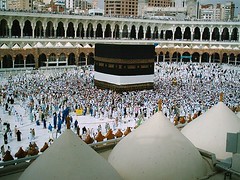 Image by *Muhammad* via Flickr
Narrated Sulaiman bin Bilal from Yahya:
Yazid Maula Al-Munba'ith heard Zaid bin Khalid al-Juham saying, "The Prophet was asked about Luqata. He said, 'Remember the description of its container and the string it is tied with, and announce it publicly for one year.' " Yazid added, "If nobody claims then the person who has found it can spend it, and it is regarded as a trust entrusted to him." Yahya said, "I do not know whether the last sentences were said by the Prophet or by Yazid." Zaid further said, "The Prophet was asked, 'What about a lost sheep?' The Prophet said, 'Take it, for it is for you or for your brother (i.e. its owner) or for the wolf." Yazid added that it should also be announced publicly. The man then asked the Prophet about a lost camel. The Prophet said, "Leave it, as it has its feet, water container (reservoir), and it will reach a place of water and eat trees till its owner finds it."
Book 3 :: Volume 42 :: Hadith 611
Narrated Zaid bin Khalid:
A man came and asked Allah's Apostle about picking a lost thing. The Prophet said, "Remember the description of its container and the string it is tied with, and make public announcement about it for one year. If the owner shows up, give it to him; otherwise, do whatever you like with it." He then asked, "What about a lost sheep?" The Prophet said, "It is for you, for your brother (i.e. its owner), or for the wolf." He further asked, "What about a lost camel?" The Prophet said, "It is none of your concern. It has its water-container (reservoir) and its feet, and it will reach water and drink it and eat the trees till its owner finds it."
Book 3 :: Volume 42 :: Hadith 612
Narrated Anas:
The Prophet passed a date fallen on the way and said, "Were I not afraid that it may be from a Sadaqa (charitable gifts), I would have eaten it."
Narrated Abu Huraira: The Prophet said, "Sometimes when I return home and find a date fallen on my bed, I pick it up in order to eat it, but I fear that it might be from a Sadaqa, so I throw it."
Book 3 :: Volume 42 :: Hadith 613
Narrated Abu Huraira:
When Allah gave victory to His Apostle over the people of Mecca, Allah's Apostle stood up among the people and after glorifying Allah, said, "Allah has prohibited fighting in Mecca and has given authority to His Apostle and the believers over it, so fighting was illegal for anyone before me, and was made legal for me for a part of a day, and it will not be legal for anyone after me. Its game should not be chased, its thorny bushes should not be uprooted, and picking up its fallen things is not allowed except for one who makes public announcement for it, and he whose relative is murdered has the option either to accept a compensation for it or to retaliate." Al-'Abbas said, "Except Al-ldhkhir, for we use it in our graves and houses." Allah's Apostle said, "Except Al-ldhkhir." Abu Shah, a Yemenite, stood up and said, "O Allah's Apostle! Get it written for me." Allah's Apostle said, "Write it for Abu Shah." (The sub-narrator asked Al-Auza'i): What did he mean by saying, "Get it written, O Allah's Apostle?" He replied, "The speech which he had heard from Allah's Apostle ."
![Reblog this post [with Zemanta]](http://img.zemanta.com/reblog_e.png?x-id=f4e2966a-15e5-4d89-a30b-5ed9909cd913)
Hadith Imam Bukhari about Loans, Payment of Loans, Freezing of Property, Bankruptcy
Jul 17, 2009 Image by mitopencourseware via Flickr
Book 3 :: Volume 41 :: Hadith 594
Narrated Abu Huraira:
Two persons, a Muslim and a Jew, quarrelled. The Muslim said, "By Him Who gave Muhammad superiority over all the people! The Jew said, "By Him Who gave Moses superiority over all the people!" At that the Muslim raised his hand and slapped the Jew on the face. The Jew went to the Prophet and informed him of what had happened between him and the Muslim. The Prophet sent for the Muslim and asked him about it. The Muslim informed him of the event. The Prophet said, "Do not give me superiority over Moses, for on the Day of Resurrection all the people will fall unconscious and I will be one of them, but I will. be the first to gain consciousness, and will see Moses standing and holding the side of the Throne (of Allah). I will not know whether (Moses) has also fallen unconscious and got up before me, or Allah has exempted him from that stroke."
Book 3 :: Volume 41 :: Hadith 595
Narrated Abu Said Al-Khudri:
While Allah's Apostle was sitting, a Jew came and said, "O Abul Qasim! One of your companions has slapped me on my face." The Prophet asked who that was. He replied that he was one of the Ansar. The Prophet sent for him, and on his arrival, he asked him whether he had beaten the Jew. He (replied in the affirmative and) said, "I heard him taking an oath in the market saying, 'By Him Who gave Moses superiority over all the human beings.' I said, 'O wicked man! (Has Allah given Moses superiority) even over Muhammad I became furious
and slapped him over his face." The Prophet said, "Do not give a prophet superiority over another, for on the Day of Resurrection all the people will fall unconscious and I will be the first to emerge from the earth, and will see Moses standing and holding one of the legs of the Throne. I will not know whether Moses has fallen unconscious or the first unconsciousness was sufficient for him."
Book 3 :: Volume 41 :: Hadith 596
Narrated Anas:
A Jew crushed the head of a girl between two stones. The girl was asked who had crushed her head, and some names were mentioned before her, and when the name of the Jew was mentioned, she nodded agreeing. The Jew was captured and when he confessed, the Prophet ordered that his head be crushed between two stones.
Book 3 :: Volume 41 :: Hadith 597
Narrated Ibn 'Umar:
A man was often cheated in buying. The Prophet said to him, "When you buy something, say (to the seller), No cheating." The man used to say so thenceforward .
Book 3 :: Volume 41 :: Hadith 598
Narrated Jabir: A man manumitted a slave and he had no other property than that, so the Prophet cancelled the manumission (and sold the slave for him). No'aim bin Al-Nahham bought the slave from him.
Book 3 :: Volume 41 :: Hadith 599
Narrated 'Abdullah bin Mas'ud:
Allah's Apostle said, "Whoever takes a false oath so as to take the property of a Muslim (illegally) will meet Allah while He will be angry with him." Al-Ash'ath said: By Allah, that saying concerned me. I had common land with a Jew, and the Jew later on denied my ownership, so I took him to the Prophet who asked me whether I had a proof of my ownership. When I replied in the negative, the Prophet asked the Jew to take an oath. I said, "O Allah's Apostle! He will take an oath and deprive me of my property." So, Allah revealed the following verse: "Verily! Those who purchase a little gain at the cost of Allah's covenant and their oaths." (3.77)
Book 3 :: Volume 41 :: Hadith 600
Narrated 'Abdullah bin Ka'b bin Malik:
Ka'b demanded his debt back from Ibn Abi Hadrad in the Mosque and their voices grew louder till Allah's Apostle heard them while he was in his house. He came out to them raising the curtain of his room and addressed Ka'b, "O Ka'b!" Ka'b replied, "Labaik, O Allah's Apostle." (He said to him), "Reduce your debt to one half," gesturing with his hand. Kab said, "I have done so, O Allah's Apostle!" On that the Prophet said to Ibn Abi Hadrad, "Get up and repay the debt, to him."
Book 3 :: Volume 41 :: Hadith 601
Narrated 'Umar bin Al-Khattab:
I heard Hisham bin Hakim bin Hizam reciting Surat-al-Furqan in a way different to that of mine. Allah's Apostle had taught it to me (in a different way). So, I was about to quarrel with him (during the prayer) but I waited till he finished, then I tied his garment round his neck and seized him by it and brought him to Allah's Apostle and said, "I have heard him reciting Surat-al-Furqan in a way different to the way you taught it to me." The Prophet ordered me to release him and asked Hisham to recite it. When he recited it, Allah s Apostle said, "It was revealed in this way." He then asked me to recite it. When I recited it, he said, "It was revealed in this way. The Qur'an has been revealed in seven different ways, so recite it in the way that is easier for you."
Book 3 :: Volume 41 :: Hadith 602
Narrated Abu Huraira:
The Prophet said, "No doubt, I intended to order somebody to pronounce the Iqama of the (compulsory congregational) prayer and then I would go to the houses of those who do not attend the prayer and burn their houses over them."
Book 3 :: Volume 41 :: Hadith 603
Narrated Aisha:
Abu bin Zam'a and Sad bin Abi Waqqas carried the case of their claim of the (ownership) of the son of a slave-qirl of Zam'a before the Prophet. Sad said, "O Allah's Apostle! My brother, before his death, told me that when I would return (to
Book 3 :: Volume 41 :: Hadith 604
Narrated Abu Huraira:
Allah's Apostle sent horsemen to
Book 3 :: Volume 41 :: Hadith 605
Narrated Abu Huraira:
The Prophet sent some horsemen to
Book 3 :: Volume 41 :: Hadith 606
Narrated 'Abdullah bin Ka'b bin Malik Al-Ansari from Ka'b bin Malik:
That 'Abdullah bin Abi Hadrad Al-Aslami owed him some debt. Ka'b met him and caught hold of him and they started talking and their voices grew loudest. The Prophet passed by them and addressed Ka'b, pointing out to him to reduce the debt to one half. So, Ka'b got one half of the debt and exempted the debtor from the other half.
Book 3 :: Volume 41 :: Hadith 607
Narrated Khabbab:
I was a blacksmith In the Pre-lslamic period of ignorance, and 'Asi bin Wail owed me some money. I went to him to demand it, but he said to me, "I will not pay you unless you reject faith in Muhammad." I replied, "By Allah, I will never disbelieve Muhammad till Allah let you die and then resurrect you." He said, "Then wait till I die and come to life again, for then I will be given property and offspring and will pay your right." So, thus revelation came: "Have you seen him who disbelieved in Our signs and yet says, 'I will be given property and offspring?' " (19.77)
![Reblog this post [with Zemanta]](http://img.zemanta.com/reblog_e.png?x-id=8af1433b-5368-4a26-91a9-9ed535799f71)


